
In today’s world where online privacy is compromised every second, people weaponize internet anonymity using VPNs (Virtual Private Networks). VPNs have become quintessential for people who seek identity concealment online. One question remains, though: Can VPNs be tracked? In this article, we will detail how VPNs function, explore whether VPNs can be tracked, and explicate why a VPN paired with SSH tunneling is perhaps one of the most effective combinations to keep someone anonymous on the internet.

How a VPN Works to Protect Your Privacy
A VPN conceals your actual IP address and location by encrypting your internet traffic and running it via a different server. Therefore,
- The ISP (Internet Service Provider) cannot monitor the websites you browse.
- Hackers are not able to collect your data from public Wi-Fi networks.
- Advertisers and different websites using servers will not be able to spy on you through your IP address.
Yet, as stated previously, the advantages differ from one VPN to another depending on the protocol configuration’s tier level used. That’s the fun part! But it also raises the question: Can VPNs be tracked even with these protections in place?
Can You Still Be Tracked While Using a VPN?
SShort answer: Yes, in certain cases. While a VPN hides your IP and encrypts your traffic, there are still ways someone could track you, leading many to ask, “Can VPNs be tracked?” Here are some scenarios where tracking is possible:
- If your VPN leaks your real IP (through DNS or WebRTC leaks).
- If your VPN provider keeps logs and shares them with authorities.
- If you log into personal accounts (like Gmail or Facebook) while connected.
- If websites use advanced tracking methods like browser fingerprinting.
In short: a basic VPN isn’t always enough to guarantee complete anonymity, and understanding whether VPNs can be tracked is crucial for maximizing your privacy.
Common Tracking Methods That Bypass VPNs
Even when a VPN is active, your privacy can still be undermined by certain methodologies, answering the question, “Can VPNs be tracked?” with some concerning possibilities.
1. Browser Fingerprinting
Various details specific to your browser, such as screen size, operating system, set fonts, and plugins, create a ‘fingerprint’ that enables people to identify and track you, even if you wish to stay hidden.
2.DNS Leaks
In the event that the VPN does not tunnel the DNS requests, they may reveal the browsing habits—websites visited—of the user to the ISP or DNS service providers.
3. WebRTC IP Leaks
WebRTC, a feature in browsers like Chrome and Firefox, can expose your actual IP address even when connected to a VPN, making it a key concern for those wondering, “Can VPNs be tracked?”
4. Active User Accounts
While connected to a VPN, personal accounts with active sessions, such as Google or Amazon, can still monitor your activity due to their range of VPN circumvention technologies.
5. Monitoring Cookies and Scripts
Web trackers often utilize multiple trackers and analytics services. These scripts are capable of setting persistent cookies that monitor your movements throughout the internet, regardless of IP changes, further highlighting why people ask, “Can VPNs be tracked?”
How to Maximize Your Anonymity with a VPN
Want true anonymity? To address concerns about whether VPNs can be tracked, follow these tips:
- Shift your browsing habits to privacy-first browsers like Brave.
- Disable WebRTC and JavaScript tracking if possible.
- Make sure the VPN’s Kill Switch is always enabled to prevent IP leaks.
- Avoid VPNs without a no-log policy.
- Use SSH tunneling capable VPNs.
And that last point is key—because SSH adds a new layer of security that typical VPNs just don’t offer.
Why SSH-Based VPNs Are the Best for Privacy
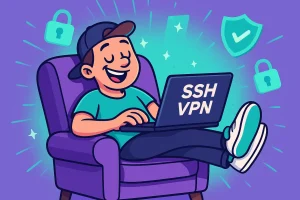
Most commercial VPNs rely on protocols like OpenVPN or WireGuard. While both are solid, SSH (Secure Shell) tunneling provides unique advantages that make it extremely difficult—if not impossible—to track your internet activity, addressing the core question, “Can VPNs be tracked?”
Here’s why:
Stronger Encryption
SSH is a standard for securely connecting to a server or remote device. The encryption used is of a very high level, making traffic decryption by third parties nearly impossible.
Bypass Censorship and Firewalls
Regions with extreme internet censorship, like China and Iran, often block VPN traffic. SSH tunnels run on common ports like 22 or 443, disguising traffic as standard, making it harder to detect and block.
Invisible to Deep Packet Inspection (DPI)
Governments and ISPs use DPI for intricate analysis of internet traffic. With SSH tunnels, your data is concealed in a way that DPI tools cannot decipher.
No Metadata Leakage
Correctly configured SSH tunnels prevent metadata, IP addresses, and DNS queries from leaking, thwarting even the most sophisticated tracking methods.
No Logging (When Self-Hosted)
A self-hosted SSH tunnel or a provider with a strict no-logs policy eliminates tracking possibilities.
Cross Platform Compatibility
SSH is supported by most operating systems, devices, and firewalls, making it a versatile privacy solution.
Advanced Obfuscation Techniques
Unlike standard VPN protocols that can sometime be fingerprinted, SSH is way more discreet. Encrypted web traffic looks like regular traffic compared to SSH.
Multi-hop Possibility
Also known as SSH hopping, SSH tunnels can be chained across multiple servers which enhances privacy and makes tracing your digital footprint that much more difficult.
Final Verdict: Are You Truly Anonymous with a VPN?
Here’s the truth: Not all VPNs are created equal. While many assume a VPN makes them invisible online, the reality is more nuanced. The question “Can VPNs be tracked?” reveals that you’re only as protected as the protocol you use, the settings you choose, and the provider you trust. If you’re serious about staying untraceable, choose a VPN that:
- Offers SSH-based tunneling
- Has a verified no-log policy
- Supports features like Kill Switch and DNS Leak Protection
- Works in high-censorship environments
VPNs relying solely on standard protocols may still expose you to tracking through browser leaks or metadata collection.
Conclusion: Want Real Privacy? Use SSH-Based VPNs
VPNs are some of the most powerful tools available for protecting your digital life. However, if you’re using a basic VPN provider with underwhelming features, you may find your privacy at risk.
Which is why, for anyone valuing privacy, we recommend VPNs that support SSH tunneling. Your traffic with SSH is encrypted, obfuscated, and to all intents and purposes stealth to detection or tracking.
Bonus Tips about This Question; Can vpns be tracked?
- Don’t log into personal accounts unless necessary.
- Use disposable browsers or incognito mode for sensitive browsing.
- Always test for DNS or WebRTC leaks after connecting.
- Consider combining Tor with SSH or VPN for layered anonymity.
Prepared to gain absolute freedom over your security settings?
Select a VPN with SSH tunneling and look through the net without restrictions.


2 Responses
https://shorturl.fm/QEx0N
This discussion feels natural and comfortable to read because the points are explained in a simple and balanced way.
kinghills casino